


Cloud buying is entering a new phase.
For years, enterprise cloud decisions have followed a familiar rhythm: human-led research, vendor conversations, pricing reviews, procurement cycles, executive approvals, and post-purchase optimization.
That rhythm is starting to change.
As agentic AI becomes more capable, cloud discovery, evaluation, sourcing, purchasing, and optimization will become more automated, more data-driven, and more dependent on machine-readable intelligence. The future cloud buying journey will not be shaped by static information alone. It will be shaped by structured data, real-time signals, trusted telemetry, direct API access, and the ability to connect spend, usage, performance, ownership, commitments, and business outcomes.
Surveil is proud to have been named as one of only three vendors in Gartner research, Emerging Tech: Agentic AI Will Reshape the Cloud Buying Journey, by Jimmy Chuang, published May 27, 2026.
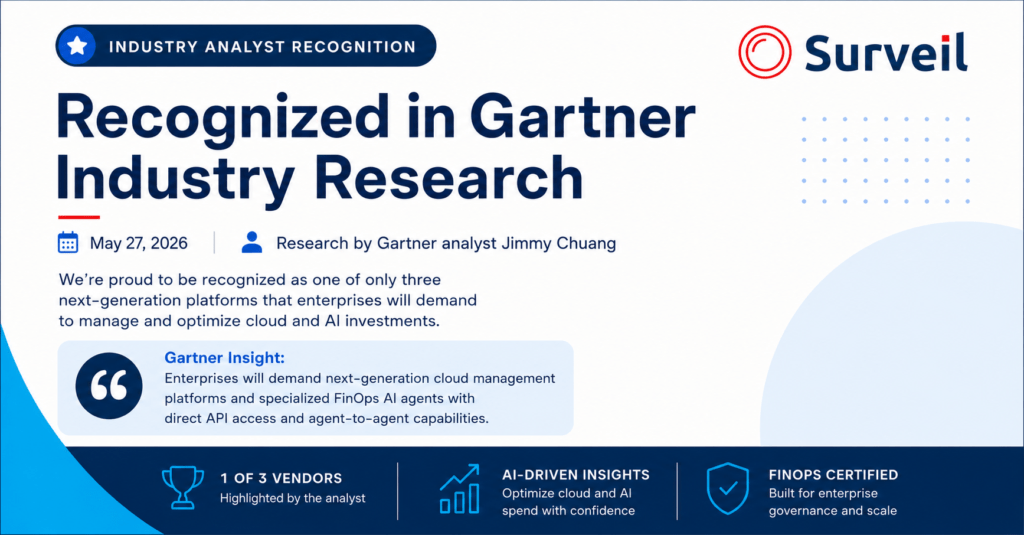
In the research, Gartner discusses how agentic AI will reshape cloud buying behavior and states that enterprises will demand next-generation cloud management platforms and specialized FinOps AI agents with direct API access and agent-to-agent capabilities to dynamically discover, validate, purchase, and optimize cloud resources in multicloud environments. Surveil was named alongside Usage.ai and Vantage FinOps Agent.
Key takeaway: Surveil was named as one of three vendors in Gartner research discussing next-generation cloud management platforms and specialized FinOps AI agents with direct API access and agent-to-agent capabilities. For enterprise teams, this points to a growing need for cloud intelligence that is real-time, structured, actionable, and ready for a more automated buying and optimization journey that delivers financial accountability for every resource, license, token, and AI agents.
How Agentic AI Is Reshaping the Cloud Buying Journey
Cloud has always moved faster than traditional procurement models.
Usage changes daily. Architecture choices influence cost. Commitments create opportunity and risk. Cloud services, SaaS platforms, and AI workloads each introduce their own pricing models, optimization paths, and governance requirements.
Agentic AI adds a new layer to that complexity.
As buying journeys become more automated, enterprise teams will need structured, trusted, and machine-readable information to support discovery, validation, purchasing, and optimization decisions. That means cloud platforms and cloud management systems will need to provide more than static reporting. They will need to support faster, data-driven decision-making across cost, usage, performance, compliance, and business context.
In practical terms, this changes the questions enterprise leaders need to answer:
- Can cloud usage be understood in real time?
- Can spend be tied to business units, applications, users, teams, or outcomes?
- Can optimization opportunities be surfaced before waste becomes embedded?
- Can commitments, renewals, and usage baselines be evaluated with trusted data?
- Can cloud resources be continuously optimized across multicloud environments?
- Can teams act on insights quickly enough to keep pace with automated buying and optimization cycles?
These are not abstract future-state questions. They are becoming near-term operating priorities for enterprise cloud, IT, finance, procurement, and FinOps teams.
Why Cloud Control Needs to Evolve
The research highlights an important market shift: the cloud buying journey is moving toward a more agent-assisted, data-driven model.
That shift matters because many enterprise teams still manage cloud decisions too broadly through fragmented tools, delayed reporting, manual analysis, and disconnected approval processes. Those models were already under pressure before agentic AI. They become even harder to sustain when cloud discovery, validation, purchasing, and optimization begin moving at greater speed.
Visibility is still essential, but visibility alone is no longer the finish line.
Enterprise teams need to move from seeing cloud spend to controlling cloud decisions. That requires:
- Clear ownership of spend, resources, and commitments
- Trusted cost and usage data across teams and environments
- Consistent tagging and classification
- Optimization recommendations that can be prioritized and tracked
- Commitment intelligence across agreements and providers
- Executive reporting that connects technical usage to business outcomes
Without that foundation, cloud buying and optimization remain reactive. With it, enterprise teams can act earlier, optimize faster, and make better investment decisions.
What This Means for Cloud Management Platforms and FinOps for AI
Gartner’s research specifically references next-generation cloud management platforms and specialized FinOps for AI with direct API access and agent-to-agent capabilities.
That is an important signal for the market.
Cloud management platforms are no longer just about collecting billing data or producing dashboards. The next phase is about helping enterprise teams dynamically discover, validate, purchase, and optimize cloud resources across multicloud environments.
That requires cloud intelligence that is:
- Real-time, so teams can act before costs are already incurred and the data behind decisions becomes outdated
- Structured, so data can be used by people, systems, and AI-assisted workflows
- Contextual, so spend can be connected to owners, applications, business units, and outcomes
- Actionable, so optimization opportunities can move from insight to execution
- Governed, so decisions remain aligned to financial, operational, and business priorities
This is where cloud financial management and cloud operations are converging. The teams responsible for cloud decisions need more than cost visibility. They need a connected control layer that helps them make smarter decisions across the full cloud lifecycle.
Surveil’s Perspective
For Surveil, this Gartner mention reinforces a market direction we believe strongly in: enterprise cloud management is moving from visibility to intelligent control.
Our perspective is shaped by active engagement across enterprise customers, partners, the FinOps community, and the broader cloud ecosystem. Across those conversations, one signal is clear: cloud decisions are becoming faster, more distributed, and more data-dependent.
Surveil helps enterprises take control of cloud, Microsoft, SaaS, and AI investments with real-time visibility, intelligent optimization, and FinOps-aligned insights. Our platform helps teams connect cost, usage, ownership, recommendations, commitments, and outcomes across complex technology estates.
For Microsoft environments, that includes Azure cost optimization, Microsoft 365 license intelligence, Copilot usage and adoption insights, and MACC visibility. For multicloud environments, it includes the financial intelligence and operational clarity teams need to reduce waste, improve accountability, and make better investment decisions.
As cloud buying becomes more automated and AI-assisted, enterprises will need trusted intelligence that can support both human decision-makers and the systems that increasingly assist them.
That is the next cloud control era.
Why This Matters Now
Cloud buying is becoming more intelligent. Cloud optimization is becoming more continuous. AI is beginning to influence how technology decisions are researched, validated, purchased, and managed.
For enterprise teams, the question is no longer:
Can we see our cloud spend?
The better question is:
Can we control, optimize, and prove the value of cloud investments as decisions become faster, more automated, and more data-driven?
That is the shift enterprise leaders should prepare for now.
Frequently Asked Questions
What Gartner research mentioned Surveil?
Surveil was named in Gartner research, Emerging Tech: Agentic AI Will Reshape the Cloud Buying Journey, by Jimmy Chuang, published May 27, 2026.
Where was Surveil mentioned in the Gartner research?
Surveil was named as one of three vendors in the context of next-generation cloud management platforms and specialized FinOps AI agents with direct API access and agent-to-agent capabilities for multicloud environments.
What are FinOps AI agents?
FinOps AI agents are emerging capabilities designed to help teams analyze, optimize, and act on cloud cost and usage data with greater speed and automation. They can support use cases such as cloud resource optimization, cost forecasting, commitment analysis, and financial governance.
Why does agentic AI matter for cloud buying?
Agentic AI has the potential to influence how cloud services are discovered, evaluated, purchased, and optimized. As buying journeys become more data-driven and automated, enterprises will need trusted, machine-readable intelligence across cost, usage, performance, compliance, and business context.
How does Surveil help with cloud control?
Surveil helps enterprises connect spend, usage, ownership, optimization opportunities, commitments, and business outcomes across cloud, Microsoft, SaaS, and AI environments. This helps IT, Finance, Procurement, FinOps, and partners make more confident cloud investment decisions.
Source reference: Gartner, Emerging Tech: Agentic AI Will Reshape the Cloud Buying Journey, Jimmy Chuang, 27 May 2026, ID G00844995.
Gartner is a registered trademark of Gartner, Inc. and/or its affiliates. Gartner research publications consist of the opinions of Gartner’s research organization and should not be construed as statements of fact. Gartner does not endorse any vendor, product, or service depicted in its research publications.