


Before evaluating the bundle, the enterprise should define the business value it expects E7 to create and identify which users, teams, and workflows can realistically produce it.
Without that clarity, the organization risks measuring the offer by what Microsoft includes rather than by what the business actually needs.
Why is Microsoft 365 E7 not a routine upgrade?
Traditional Microsoft 365 upgrades could often be justified through relatively familiar outcomes. The organization gained stronger security, more advanced compliance capabilities, additional communications tools, or an opportunity to consolidate overlapping vendors.
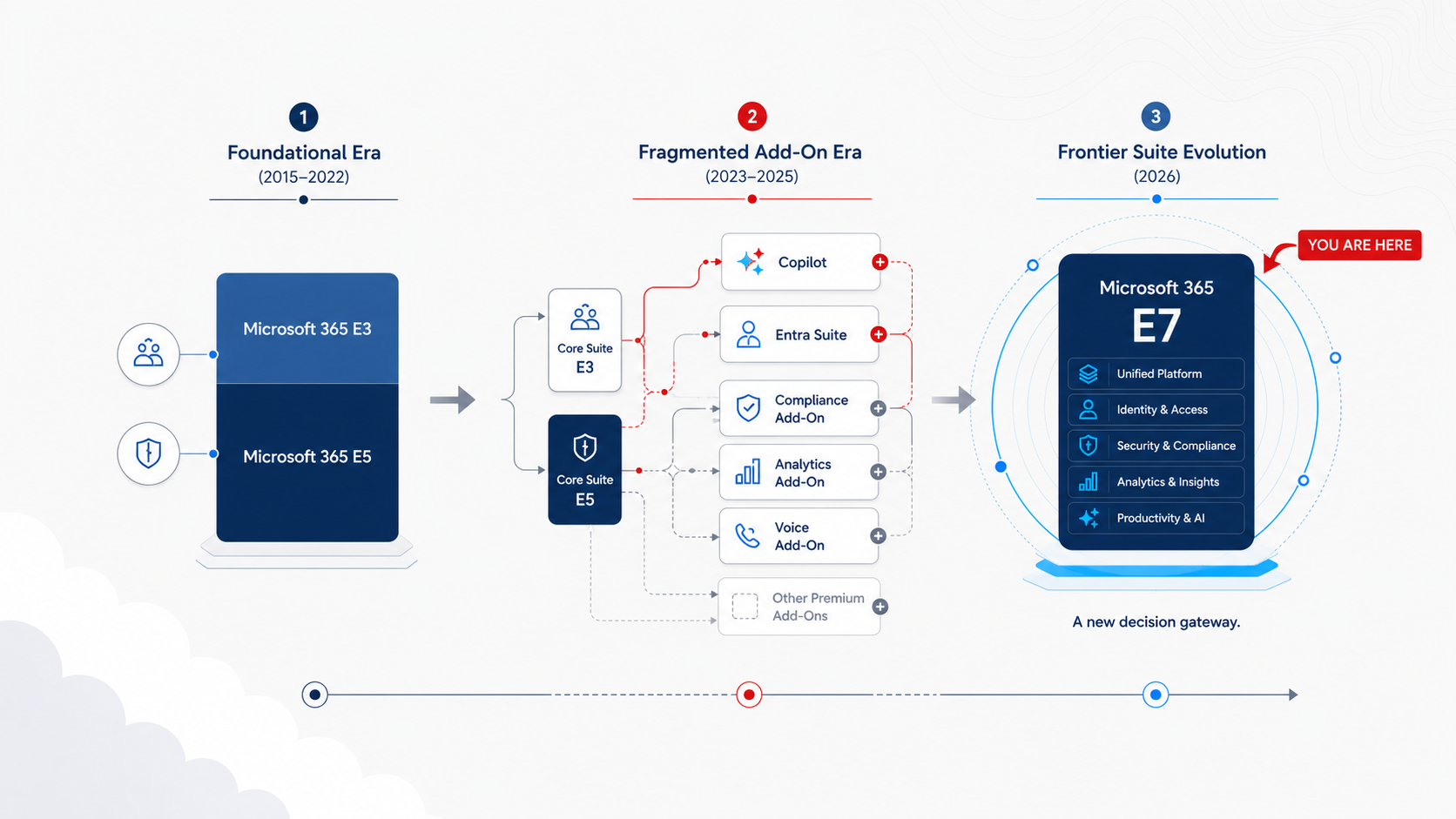
E7 changes the scale of the decision.
It brings together productivity, Microsoft 365 Copilot, agent management, identity, and security capabilities under one premium proposition. The potential value does not come from simply making more technology available. It comes from the enterprise being ready to use those capabilities together.
That requires more than technical eligibility.
The workforce must have credible demand for Copilot. Business teams need workflows where AI can improve speed, quality, or capacity. Agent initiatives must be mature enough to justify additional governance. Identity and security requirements must be significant enough to support the investment. Finance must understand who owns the cost and how future demand will be forecast.
If those conditions do not exist, E7 can become a large collection of future possibilities funded by current budget.
A broader bundle does not create a broader business case.
Start with the outcome, not the bundle
A strong E7 evaluation should begin with the outcomes the enterprise is trying to achieve.
Examples may include:
- Expanding Copilot among employees already demonstrating strong adoption
- Reducing the time required for high-value knowledge workflows
- Governing a growing estate of Microsoft and third-party AI agents
- Improving identity controls across users, agents, applications, and data
- Consolidating specific security or governance capabilities
- Creating a more consistent operating model for AI-enabled work
Each expected outcome should have an accountable owner, a target population, and evidence that the need is real.
For example, “scale Copilot” is not a complete value hypothesis. Which users should receive it? Which workflows will change? What adoption level is credible? What improvement should the business expect? How will the organization respond if adoption remains weak?
“Improve agent governance” is equally incomplete without a clear view of how many agents exist, who owns them, where they operate, what data they access, and whether they are moving into production.
The bundle should support the strategy. It should not become the strategy.
Not every Microsoft 365 user will create equal E7 value
One of the greatest risks in premium Microsoft bundles is the assumption that the same package should be applied broadly across the workforce.
Employees have different roles, application patterns, security needs, AI maturity, and opportunities to benefit. A knowledge worker building agents and using Copilot across complex workflows may have a strong case for E7. Another user may need only a subset of the included capabilities.
Without user and business profiling, the enterprise may pay for advanced AI, governance, identity, and security capabilities across populations that will not use them.
A stronger approach segments the workforce according to:
- Current Microsoft 365 behavior
- Copilot readiness and adoption
- Role and workflow complexity
- Security and identity requirements
- Agent creation or interaction
- Business ownership
- Expected value
This does not require the organization to become a licensing expert. It requires the organization to understand its own users and demand before entering a larger commercial discussion.
Do not confuse access with readiness
E7 can make advanced capability easier to acquire. That does not make it easier to absorb.
Many enterprises are still working through uneven Copilot adoption, limited AI literacy, fragmented ownership, unclear value measurement, and immature agent programs. Adding more capability before those operating gaps are resolved can deepen the problem.
The enterprise may gain tools for agent control before it has a defined agent lifecycle. It may expand Copilot access before it knows which users are creating value. It may add identity and security functionality while existing features remain underused.
The result is not transformation. It is a larger estate to manage.
Readiness is the ability to use, govern, optimize, and measure the capability, not simply the ability to purchase it.
Define value before Microsoft defines the comparison
Microsoft will naturally compare E7 with the organization’s current Microsoft footprint and the cost of purchasing individual capabilities separately.
That comparison may be useful, but it is not sufficient.
The enterprise also needs to compare E7 with its actual future requirements.
That means understanding:
- Which existing capabilities are actively used
- Which current investments should be optimized first
- How many users have credible Copilot demand
- Whether agent activity justifies broader governance
- Which security and identity requirements are unmet
- What alternative approaches remain viable
- How much flexibility the organization needs as Microsoft and AI continue to change
Without this baseline, a discount can make the future offer appear more attractive than it really is because the comparison begins with an unoptimized current state.
A better decision starts with the enterprise’s own evidence.
What value should E7 create?
Before approving E7, leadership should be able to state the expected value in clear business terms.
A defensible value case might include:
- More Copilot investment directed toward proven user groups
- Faster or higher-quality work in defined business processes
- Reduced risk as agent activity expands
- Improved accountability across AI usage and spend
- Elimination of specific redundant tools or costs
- Stronger identity and security controls tied to measurable requirements
- A more efficient operating model across Microsoft 365, Copilot, Azure, and AI
If the enterprise cannot explain the expected value, identify the target population, and establish how progress will be measured, it is not yet evaluating E7. It is evaluating a bundle.
How Surveil helps
Surveil, a FinOps Certified Platform, helps enterprises evaluate Microsoft 365 E7 using accurate intelligence across the entire Microsoft estate. By connecting Azure consumption, Microsoft 365, Copilot, and AI data in one place, Surveil gives Finance, FinOps, IT, Procurement, Security, and business leaders a unified view of current utilization, user readiness, adoption, cost, business ownership, optimization opportunities, and future demand.
Real Microsoft 365 engagement data helps identify which users are likely to benefit from advanced capabilities. Copilot intelligence shows where adoption is sustained and where value may be deteriorating. Azure and AI data reveal how wider consumption, agents, and emerging workloads affect the financial picture. Smart Tagging connects those signals to departments, cost centers, personas, initiatives, and accountable owners.
Surveil turns that connected intelligence into recommendations, forecasts, and optimization actions that help the enterprise define what value it expects, where E7 may be justified, and which assumptions should be challenged before renewal. The result is not another Microsoft dashboard. It is the evidence required to evaluate E7 from the needs of the business rather than the contents of the bundle.
Schedule a Surveil Microsoft estate health check to assess utilization, Copilot readiness, AI demand, optimization, and renewal-planning gaps. Or request a demo to see how Surveil connects Microsoft 365, Copilot, Azure, and AI intelligence in one place.