


Why Enterprise Financial Governance Must Catch Up to AI Scale in 2026
The industry conversation around AI feels confident.
Tooling is improving.
FinOps adoption is expanding.
Governance frameworks are maturing.
Recent research from the FinOps Foundation and Gartner reflects this momentum, highlighting growing demand for AI cost visibility, forecasting discipline, and structured trade-offs in procurement. But beneath that progress is a structural shift that deserves more attention.
AI is scaling faster than enterprise financial control systems were designed to handle.
That does not mean organizations lack visibility. It means the architecture of spend has changed, and many enterprises are still adapting their financial discipline to match it. That gap is where volatility forms.
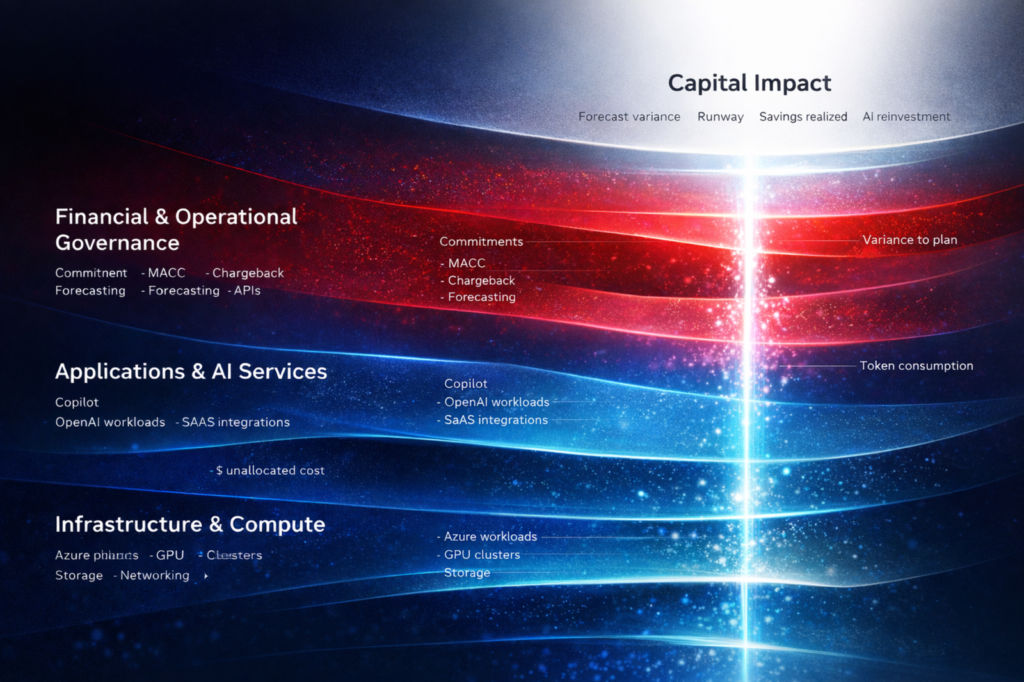
AI Didn’t Create a New Budget. It Rewired the Stack.
For years, cloud cost was compartmentalized enough to manage. Compute, storage, networking, licensing. Imperfect, but traceable.
AI does not sit neatly inside those boundaries.
It embeds.
- GPU acceleration inside existing workloads.
- Token-based consumption layered into APIs.
- AI-enabled SaaS features bundled into productivity platforms.
- Agents triggering cascaded service interactions.
- Data pipelines expanding to support model training and inference.
These do not appear as a clean “AI initiative.” They appear as incremental growth inside systems that already exist.
That is precisely why exposure is easy to underestimate.
From an engineering standpoint, it feels like capability expansion. From a financial standpoint, it behaves like layered dependency.
And layered dependency compounds.
AI Cost Behavior Is Structurally Different
AI is the first major enterprise technology wave where cost scales with human behavior as much as infrastructure provisioning. Token usage increases with adoption patterns. Agents generate multi-service execution chains. Model upgrades alter pricing characteristics midstream. Experimentation produces burst consumption that distorts steady-state assumptions.
Traditional cloud cost models were built around relatively stable provisioning curves. AI introduces behavioral volatility layered onto infrastructure. For CFOs and IT finance leaders, that volatility is not theoretical. It affects forecast confidence. When forecast confidence drops, capital allocation tightens.
Innovation does not slow because of technology constraints. It slows because financial ambiguity makes leadership cautious.
The Trade-Off That Shapes Long-Term Exposure
Every AI investment involves competing objectives:
- Speed to deployment.
- Cost discipline.
- Contract flexibility.
- Risk mitigation.
Maximizing all four simultaneously is unrealistic. Accelerate deployment and negotiation leverage narrows. Demand flexibility and pricing structures shift upward. Optimize aggressively for cost and experimentation slows. Over-index on risk and agility diminishes.
The difference between mature and immature governance is not whether trade-offs exist. It is whether they are surfaced explicitly. Organizations with disciplined FinOps practices define priorities early. Organizations without that discipline often discover financial constraints later, when commitments are embedded and adoption patterns are set. This is not a failure of AI. It is a failure of orchestration.
Monitoring Usage Is Not the Same as Governing Exposure
Many enterprises now track AI usage with increasing granularity.
Token dashboards exist.
GPU utilization is measurable.
API activity is visible.
That is progress.
But telemetry is not financial control. Financial control requires answering more consequential questions:
- How much of our cloud growth is structurally AI-driven?
- Which business units are increasing long-term AI dependency?
- Are multiyear commitments aligned with actual adoption curves?
- Can we demonstrate AI return with financial evidence, not inferred productivity gains?
These are governance questions.
Without disciplined allocation, scenario modeling, and commitment visibility, the hallmarks of mature FinOps practices, exposure builds quietly beneath usage metrics. Cloud engineers see performance improvements. Finance sees operating margin sensitivity. Until those views are unified, neither side sees the full financial reality.
Architecture Is Now a Capital Allocation Decision
Architecture decisions are no longer purely technical. Model selection influences long-term pricing dynamics. Agent design affects cross-service consumption patterns. Commitment structures shape flexibility for years. Data architecture determines compounding storage and processing costs. These decisions influence EBITDA trajectory, cash flow predictability, and margin resilience.
Most boards may not articulate it in architectural language. But they feel it when cloud growth begins to outpace revenue growth.
Technical leadership is now shaping financial trajectory, whether that responsibility is formally acknowledged or not.
Enterprises that recognize this early will scale AI more deliberately.
FinOps Maturity Is the Divider
Not every enterprise is equally exposed.
Organizations with disciplined, governance-driven FinOps practices are better positioned to quantify AI financial exposure before scaling aggressively. They model scenarios. They align commitments with adoption curves. They attribute cost with accountability.
Enterprises without that maturity often scale first and rationalize later.
The difference does not show up in innovation headlines. It shows up in financial stability.
AI does not penalize ambition. It penalizes ambiguity.
A More Deliberate Path Forward
If AI is embedded across the stack, financial discipline must embed alongside it. That requires four deliberate motions:
- DISCOVER full-stack AI exposure across infrastructure, SaaS, identity, data, and model consumption layers.
- DECIDE explicitly which trade-offs matter before commitments compound.
- DEPLOY financial guardrails into engineering and procurement workflows, not after overruns occur.
- DELIVER validated outcomes that withstand CFO and board-level scrutiny.
This is not about slowing AI adoption. It is about ensuring acceleration does not erode financial integrity.
Where Surveil Fits
This is precisely the discipline the Surveil platform was built to enable. Not by adding another monitoring layer. But by helping enterprises:
- Discover true AI exposure across Azure, Microsoft 365, and multi-cloud environments.
- Surface commitment misalignment before it compounds.
- Model trade-offs prior to scaling AI workloads.
- Embed governance into operational workflows.
- Validate savings, utilization efficiency, and ROI with defensible financial intelligence.
By identifying structural inefficiencies and commitment gaps early, organizations can redirect recovered capital toward deliberate AI initiatives and fund acceleration intentionally rather than absorbing volatility as unplanned spend. For cloud infrastructure leaders, that means architectural clarity tied directly to cost consequence. For FinOps practitioners, it means allocation integrity and commitment visibility. For CFOs and IT finance heads, it means forecast confidence in an AI-driven operating model.
AI acceleration is not the risk. Acceleration without financial discipline is.
Enterprises that align architecture, governance, and financial orchestration will not simply manage AI cost. They will convert AI into a controlled strategic advantage.
For Readers Who Want Direct Answers
What is AI financial exposure?
AI financial exposure is the total economic dependency created by AI across infrastructure, SaaS platforms, data pipelines, model consumption, contracts, and architectural decisions, not just visible token or GPU usage.
Why is AI cost management more complex than traditional cloud cost management?
AI workloads scale with user behavior, introduce multi-service interactions, and rely on evolving pricing models. This creates non-linear consumption patterns that traditional cloud forecasting frameworks were not designed to handle.
How does FinOps maturity influence AI cost control?
Mature FinOps practices introduce governance discipline, allocation transparency, commitment modeling, and scenario planning. Without that structure, AI exposure becomes fragmented and difficult to forecast accurately.
Why do AI forecasts often fail?
AI adoption patterns are volatile, pricing structures evolve, and architectural dependencies compound. Forecast models built for steady-state cloud consumption often underestimate these variables.
Who should own AI financial governance?
AI financial governance requires shared ownership between cloud engineering, FinOps, procurement, and finance. Architecture decisions now directly influence long-term capital exposure and operating margin sensitivity.