


The next FinOps question is not just, “What did AI cost?”
It is, “What was it worth?”
That is where the conversation gets more uncomfortable, and more useful.
For years, FinOps has helped enterprises bring discipline to cloud spend. The practice gave teams language, operating models, and financial accountability around variable consumption. It helped IT, finance, engineering, and business leaders get better at understanding cloud usage, allocating costs, optimizing waste, and improving forecasting.
AI raises the stakes because consumption does not just come from infrastructure anymore. It can come from a model choice, a prompt pattern, an agentic workflow, a Copilot license, an autonomous process, a SaaS AI feature, or a business team experimenting faster than governance can keep up.
That means the old question, “How much did we spend?” is too narrow.
The better question is, “What business activity did that spend support, who owns it, and should we fund it again?”
That is the real shift.
Token cost matters, but it is not the whole story
Token economics are going to become a serious operating discipline. Teams will need to understand cost per token, input and output ratios, model routing, caching, provisioned throughput, and consumption drift. Those signals matter because they help teams forecast and optimize.
But token cost alone does not tell you whether AI created value.
A cheaper model is not automatically a better decision. A lower-cost prompt is not automatically a better outcome. A highly used AI service is not automatically a successful investment.
Executives do not fund tokens. They fund business outcomes.
That is why the more interesting FinOps for AI conversation is not “How do we make tokens cheaper?” It is “How do we connect AI consumption to value?”
The most mature teams will move from cost per token to cost per intelligent outcome. That could mean cost per resolved ticket, cost per automated workflow, cost per customer interaction, cost per product decision, cost per engineering task, cost per forecast, or cost per business process improved.
There will not be one universal metric. Every business will need its own model. But the direction matters. The unit of analysis has to move closer to the business.
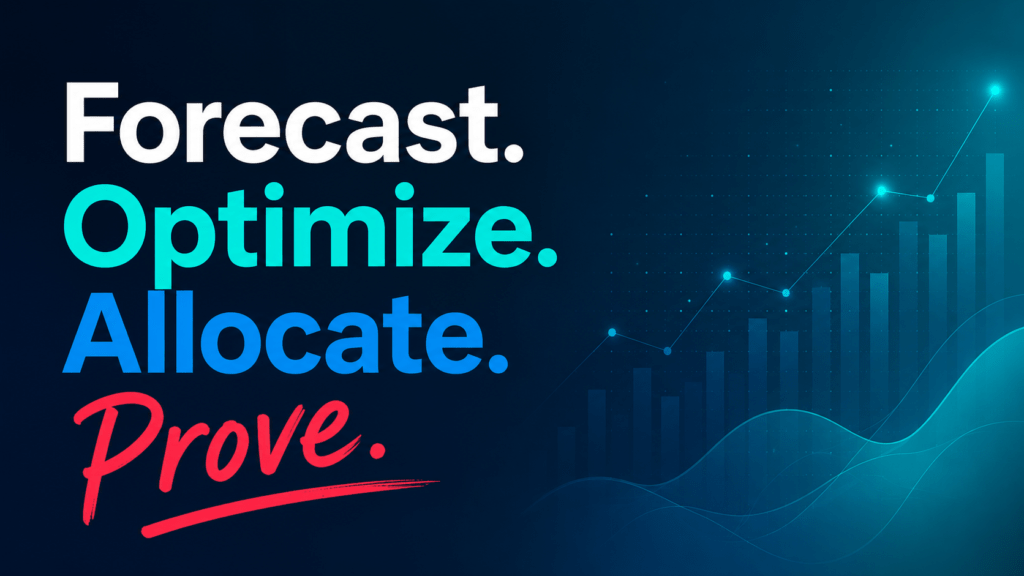
Forecast. Optimize. Allocate. Prove.
One of the strongest themes from the keynote was the need to forecast, optimize, and allocate AI spend. I agree with that completely. But I would add a fourth word:
Prove.
Forecasting helps teams plan for usage that can change quickly. Optimization helps teams improve cost and performance decisions. Allocation helps teams connect spend to the right owners.
But proof is what earns executive confidence.
Proof answers the questions leadership will eventually ask: Did this AI investment improve productivity? Did it reduce manual effort? Did it accelerate a business process? Did it improve margin, speed, customer experience, risk posture, or decision quality? Did it create enough value to justify scaling?
Without that proof, AI spend becomes another area where the enterprise can see activity but cannot confidently defend investment.
That is not a reporting issue. It is an accountability issue.
The AI accountability gap
Most enterprises are going to face an AI accountability gap.
This is the space between what a company can observe and what it can actually explain, allocate, govern, predict, and prove.
It shows up when AI spend is visible, but ownership is unclear. It shows up when Copilot licenses are assigned, but usage and value vary dramatically across teams. It shows up when AI agents execute work, but no one can explain which business process they supported or whether the outcome was worth the cost.
The accountability gap gets wider when AI moves faster than the operating model around it.
That is why FinOps for AI needs to be more than a dashboard category. Dashboards can show what happened. They do not automatically tell teams what to do next.
The work ahead is to build a financial control model where finance, FinOps, engineering, IT, AI operations, and business leaders can make better decisions from the same context.
The four questions that matter now
For me, the emerging AI FinOps operating model comes down to four questions.
First, what did we consume? Teams need visibility across AI services, models, agents, tokens, Copilot usage, SaaS AI capabilities, and cloud infrastructure.
Second, who owns it? AI spend needs to connect to business units, teams, products, applications, initiatives, and accountable owners.
Third, was it worth it? Usage needs to be connected to business activity and measurable outcomes, not just consumption volume.
Fourth, what is likely to happen next, and should it? This is where forecasting, governance, optimization, and decision-making come together. Should the workload use the same model? Should an agent have a spending threshold? Should the use case scale, pause, or be redesigned? Where is spend likely to drift if usage continues? Which AI activity is becoming material enough to require stronger controls?
That fourth question may become the most important one.
FinOps for AI cannot simply explain the bill after AI work happens. It has to help organizations predict what may happen next, shape the decisions that follow, and determine whether that activity should happen again.
Where Surveil is placing its bet
This is the conversation we are focused on at Surveil.
We believe enterprises need a financial accountability layer for AI that connects spend, usage, consumption, ownership, governance, and business outcomes through a shared operational and financial context.
That business context is critical.
AI spend by itself only tells part of the story. It becomes useful when it is connected to the business unit funding it, the team using it, the application or workflow driving it, the model or agent consuming it, and the initiative it is meant to support.
That is where AI financial control starts to become practical. Not just seeing that spend increased, but understanding why it increased, who is accountable, whether it was expected, where it may go next, and whether it is tied to measurable value.
That is why we launched Surveil for AI and opened our Early Access Program. Surveil for AI is built into the Surveil platform to help organizations monitor, allocate, forecast, optimize, govern, measure, and prove ROI across Azure AI, Microsoft 365 Copilot, Microsoft 365 Copilot Agents, Anthropic Claude, and emerging AI services.
The goal is not just to help teams see AI spend. It is to help them bring business context to AI consumption so finance, FinOps, IT, engineering, AI operations, and executive teams can make smarter decisions from the same foundation.
No one has the full AI FinOps playbook yet
That is the point.
The best models will be built with practitioners who are solving these problems in real environments right now. Teams are already wrestling with forecasting volatility, allocating shared AI services, measuring Copilot value, governing agent behavior, and translating AI consumption into business language leaders can act on.
AI is not making FinOps less important. It is making FinOps more business-critical.
The teams that lead will not be the ones that only report what AI cost. They will be the ones that help the business predict what may happen next, prove which investments are creating value, and decide which AI initiatives deserve to scale.
Because the next FinOps question is not, “What did AI cost?”
It is, “What was it worth?”